Scale
Scale:规模
The hidden math behind why elephants outlive mice, why cities never die, and why companies do. Geoffrey West takes forty years of physics, biology, and urban data and writes them down as one set of curves.
为什么大象比老鼠活得久?为什么城市几乎从不消亡,而公司却一家接一家地死?杰弗里·韦斯特把他四十年的物理学、生物学与城市数据研究,归结成同一组曲线——一条方程,解释三个看起来毫无关系的世界。
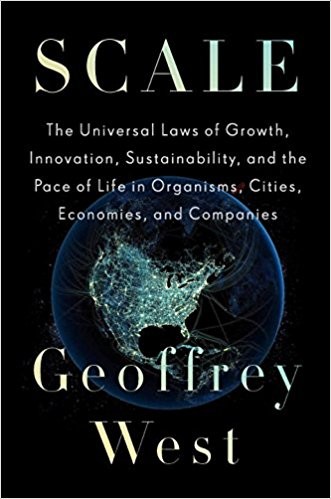 Get the book
获取本书
Get the book
获取本书
"The bigger you are, the slower everything is. The bigger you are, you live longer."
「你越大,一切就走得越慢;你越大,你活得就越久。」
— Geoffrey West, Edge.org conversation, 2011
—— 杰弗里·韦斯特,Edge.org 访谈,2011年
📐 The Universal Pattern
📐 通用规律
Before the book tells you anything about mice or cities, it tells you about a shape — the shape of a power law. Get that shape right, and every chapter that follows makes sense.
在讲老鼠、讲大象、讲东京之前,这本书先让你看一个形状——幂律曲线的形状。看懂了这个形状,后面每一章都会一下子说得通。
Bigger ≠ Proportionally More
变大 ≠ 按比例变多
In nature, almost nothing doubles when it doubles in size. Double a mouse in mass and its heart doesn't beat twice as often — it beats roughly 19% slower. Double a city's population and its road network doesn't need twice the asphalt — it needs about 85% more. This is the book's opening move: size changes things non-linearly, and the "how much" is written in a single equation.
在自然界里,当一样东西变大一倍,里面的一切几乎都不会"刚好"也跟着翻倍。把老鼠体重翻一倍,它的心跳并不会变快一倍——反而慢了大约19%。把一座城市的人口翻一倍,路网也不需要多铺一倍——只需要多出约85%就够。这就是这本书的开场动作:尺寸会以非线性的方式改变一切,而这个"多多少",可以写成一条方程。
Y = c × Xα
Y = c × Xα
Y is the quantity you care about; X is size; α is the scaling exponent. The whole book is a tour of what α turns out to be — and why.
Y 是你想了解的量,X 是尺寸,α 是那个"缩放指数"。整本书就是在讲——α 到底是多少,以及它为什么是这样。
Three Flavors of Alpha
α 有三种玩法
There are only three possibilities, and each one tells a different story about the system underneath.
α 只有三种可能,每一种都在讲一个不同的故事,关于这系统底下到底是什么。
When wildly different systems land on the same α, it's a clue that the networks underneath — blood vessels, roads, wires, social connections — share the same geometry. That's the book's bet: the geometry is the law.
当毫不相干的系统落在同一个 α 上,这就是线索:它们底下那些"网络"——血管、路网、电线、社交连接——共享着同一种几何学。这本书的赌注就在这里:几何,就是法则。
The Network Is the Law
那张"网络",就是那条法则
West and his SFI collaborators made one bold claim that sets the book apart from earlier observations of scaling. The patterns aren't coincidences; they fall out of the shape of the distribution networks that keep any complex system alive. A mammal's cardiovascular system is a space-filling fractal tree. A city's road and utility grid is, too. The hierarchy — from trunk to twig, from highway to cul-de-sac — forces the math. Once you accept that premise, the exponents stop being mysterious and start being predictable.
韦斯特和他在圣塔菲研究所的同事们,做了一件大胆的事,把这些规模律和此前那些"巧合式的观察"区分开。他们说,这些规律不是巧合——它们是从"维持一个复杂系统运转所需的那张分配网络的形状"里直接推导出来的。哺乳动物的心血管系统是一棵充满空间的分形树,一座城市的路网与管网也是。从主干到末梢,从高速公路到死胡同,这种分级结构强制决定了那条方程。你一旦接受了这个前提,那些指数就不再神秘——它们开始变得可以预测。
🧬 Biology: Why Bigger Is Slower
🧬 生物学:为什么越大越慢
In 1932, a Swiss agricultural scientist named Max Kleiber plotted the basal metabolic rate of animals — from pigeons to cows — against their body mass. The line on the log-log plot had a slope of three-quarters. That one slope has outlived its author by almost a century, and it is the book's biological anchor.
1932年,瑞士农业科学家马克斯·克莱伯把各种动物——从鸽子到母牛——的基础代谢率对着体重画了一张图。在双对数坐标里,那条线的斜率正好是 3/4。这个斜率比它的作者多活了快一个世纪——它是这本书在生物学上的锚点。
¾ Is Everywhere (In Mammals and Birds)
¾,在哺乳类和鸟类里无处不在
Metabolism — the total rate at which an organism burns energy — scales with body mass raised to the ¾ power. Double the mass; metabolic rate goes up by a factor of 2¾ ≈ 1.68, not 2. Bigger animals burn fewer calories per kilogram than smaller ones. A whale's cells are metabolically lazier than a mouse's, not because they are different cells, but because the blood network feeding them has a different geometry. The pattern is strikingly robust across mammals and birds, spanning more than twenty orders of magnitude of mass.
代谢——一个生物燃烧能量的总速率——按体重的 ¾ 次幂缩放。体重翻一倍,代谢率上涨的倍数是 2¾ ≈ 1.68 倍,不是 2 倍。越大的动物,单位体重反而越省能量。一头鲸的细胞比老鼠的细胞"懒",不是因为它们是别种细胞,而是因为给它们供血的那张网络,几何学不同。这条规律在哺乳类和鸟类之间极其稳定,跨越了二十多个数量级的体重区间。
West, Brown, and Enquist (1997, Science) derived the ¾ exponent from three assumptions: the network is space-filling, the terminal units (capillaries) are size-invariant, and the system minimizes energy dissipation. The result matches data closely enough to feel like a law — at least for the warm-blooded clade.
韦斯特、布朗、恩奎斯特在1997年《科学》杂志上的那篇论文,用三条假设为这个 ¾ 给出了物理学推导:网络充满空间;末端单元(毛细血管)与体型无关;系统让能量耗散最小化。推导结果与数据吻合得像一条定律——至少,对恒温动物而言。
Time Itself Scales
连时间本身也会缩放
Once metabolism scales as M¾, lifespan falls out as M¼ and heart rate as M–¼. The numbers are uncanny. A mouse lives 2–3 years at ~600 beats per minute. A human lives ~80 years at ~70 bpm. A blue whale lives over a century at ~10 bpm. Multiply heart rate by lifespan for each of them and you land on roughly the same number of heartbeats. Time, in biology, is not absolute — it runs slower for larger bodies.
一旦代谢按 M¾ 缩放,寿命就按 M¼ 缩放,心率按 M–¼ 缩放。这些数字真的让人起鸡皮疙瘩:老鼠活 2–3 年,心率约 600 次/分钟;人类活约 80 年,心率约 70;蓝鲸活过百年,心率约 10。把每一个的心率乘以寿命,你会发现结果大致相同——就在那么几个数量级内的一个数。时间,在生物学里,不是绝对的——体型越大,时间走得越慢。
Mammals and Birds, Maybe
哺乳类和鸟类,也许而已
West presents ¾ as a near-universal biological law, and in the book's domain it mostly is. But the story has a sharp edge. Ian Hatton and colleagues (2019, PNAS) reanalyzed metabolic scaling across the eukaryotic tree — plants, protists, microbes included — and found the pooled exponent sits much closer to 1 than to ¾. Kleiber's ¾ survives cleanly for mammals and birds; it frays when you include all of life. The honest reading of Scale is that it names one of biology's strongest regularities, not a Newton's-second-law-style universal.
韦斯特把 ¾ 写成一条接近普适的生物学定律,在书的题材范围内基本站得住脚。但故事有一条锋利的边。2019年,伊恩·哈顿等人在《美国国家科学院院刊》上重新分析了所有真核生物——植物、原生生物、微生物都算进来——发现汇总后的指数远远脱离 ¾,更贴近 1。克莱伯的 ¾,对哺乳类和鸟类能立得住;你把"所有生命"都算进来的时候,它就开始松动。所以读《规模》这本书的诚实姿态,是把它当成"生物学里最稳健的规律之一",而不是像牛顿第二定律那样"宇宙级普适"。
🏙 Cities: Two Exponents, One Place
🏙 城市:同一座城,两个指数
This is the chapter that made Scale famous outside the lab. Geoffrey West, Luis Bettencourt, and collaborators at SFI looked at cities the way biologists look at organisms — and found a pair of numbers that changes how you read an urban map.
这是让这本书走出实验室、成为城市话题的那一章。韦斯特、路易斯·贝当古和圣塔菲研究所的合作者们,用看生物的方式去看城市——找出了一对数字,看过之后你再看一张城市地图,角度完全不同。
One City, Two Scaling Laws
同一座城市,两种截然相反的缩放方式
Bettencourt, Lobo, Helbing, Kühnert, and West (2007, PNAS) analyzed data across hundreds of cities in multiple countries. The result was a clean bifurcation: physical infrastructure and social outputs scale by different exponents — and the sign of the difference tells you everything about what cities actually do.
贝当古、洛波、海尔宾、屈纳特、韦斯特,2007年发表在《PNAS》上的论文分析了多个国家数百座城市的数据。结果是一个干净的分叉:物理基础设施和社会产出,按不同的指数缩放——而这两个指数之间的差值的符号,告诉你城市到底在做什么。
Sublinear: α ≈ 0.85
次线性:α ≈ 0.85
Roads, gas stations, water pipes, electrical cables, total road surface — all of these scale sublinearly with a city's population, with an exponent close to 0.85. Double a city's size and the physical fabric needs only about 85% more, not 100%. It's the same efficiency signature as a whale's vascular network: hierarchical distribution, shared trunks, economy of scale. In per-capita terms, infrastructure demand drops by ~15% with each doubling of city size. Big cities are greener — at least in that one sense — than small ones.
道路、加油站、水管、电缆、路面总面积——这些量跟城市人口之间呈次线性关系,指数接近 0.85。城市规模翻一倍,物理基础设施只需要增加大约85%,不是100%。这和一头鲸的血管网络是同一种效率签名:分级分配、共享主干、规模经济。换算成"人均":每一次城市规模翻倍,人均基础设施需求下降约15%。大城市比小城市"更绿色"——至少在这一个维度上。
Superlinear: α ≈ 1.15
超线性:α ≈ 1.15
Wages, GDP, patents filed, inventors produced, R&D employment, walking speed, AIDS cases, violent crimes, flu transmissions — every quantity that depends on people interacting with other people scales with an exponent near 1.15. Double the population and each of these goes up by about 15% per person, both the goods and the ills. Cities concentrate opportunity and pathology on the same curve. The engine is density: more people per square kilometer means more accidental encounters — more idea-collisions and more disease-vector collisions. You can't pick up only the upside half.
工资、GDP、专利数、发明者数量、研发从业者、走路速度、艾滋病例、暴力犯罪、流感传播——所有"依赖于人与人互动"的量,它们的指数都接近 1.15。人口翻倍,这些量"人均"都增长约 15%——好的和坏的都是。城市把机会和病理学放在同一条曲线上。驱动这一切的,是密度:每平方公里多一个人,意味着每天多几次"偶遇",意味着多几次点子之间的碰撞,也意味着多几次病菌传播路径的碰撞。你没办法只挑"好的那一半"。
Cities Are Scaled Versions of Each Other
每座城市,都是另一座的放大缩小版
One of the book's bolder claims: to a striking degree, every city is a scaled-up or scaled-down version of every other city within the same country's urban system. Given a country's largest metro, the smaller ones are roughly predictable by the two exponents — 0.85 for infrastructure, 1.15 for socioeconomic outputs. Local character, climate, history, culture all matter, but they matter as deviations around the curve, not as drivers of the curve itself. The shape is the same everywhere.
这本书的一个大胆断言:在相当惊人的程度上,同一个国家的城市体系里,每一座城市都是另一座城市"放大"或"缩小"的版本。只要你知道这个国家最大的那个都会区,凭那两个指数——0.85 与 1.15——你就能大致预测其他城市。地方文化、气候、历史、风土,这些都重要,但它们的作用是让数据点在曲线上下浮动,并不决定曲线本身。那个形状,在哪里都一样。
"Companies are more like organisms — they grow, then converge. Cities are open-ended."
「公司更像生物——它们成长,然后收敛。城市则是开放式的。」
— Geoffrey West, Edge.org conversation
—— 杰弗里·韦斯特,Edge.org 访谈
🏢 Companies: Why They Die
🏢 公司:它们为什么会死
Here the book turns unsettling. If cities are superlinear and never die, and organisms are sublinear and always do, what are companies? West's team analyzed tens of thousands of public US companies from Compustat and asked the same question in data.
这里,这本书开始让人不太舒服。如果城市是超线性的、几乎不会消亡,而生物是次线性的、终会一死,那公司是什么?韦斯特的团队从 Compustat 数据库里拉出数以万计的美国上市公司,用同样的方法问了同一个问题。
Sublinear: α ≈ 0.9
次线性:α ≈ 0.9
Revenues, assets, employees — at least across public US firms — scale sublinearly with company size. Bigger firms are more efficient per employee, not less. On this dimension, a corporation looks more like a whale than a city: a hierarchical distribution network (management, reporting lines, shared services) with its own economies of scale. But there's a catch.
收入、资产、员工数量——至少在美国上市公司这个群体里——它们跟公司规模之间是次线性关系。公司越大,每个员工的平均效率越高,不是越低。在这个维度上,公司看起来更像一头鲸,而不是一座城市:一张分级分配的网络(管理层、汇报线、共享服务),有它自己的规模经济。但这里有一个陷阱。
Daepp, Hamilton, West, and Bettencourt (2015, J. Royal Society Interface) examined more than 25,000 publicly traded companies from 1950–2009. The curve bends. Companies grow fast when young, then asymptote, then start dying in predictable numbers.
Daepp、Hamilton、West、Bettencourt 在 2015 年《英国皇家学会界面期刊》上的论文,分析了25,000多家美国上市公司,时间跨度 1950–2009。那条曲线会弯下去。公司年轻时长得飞快,然后增速放缓,然后按照一定的节奏开始消亡。
A Half-Life of About Ten Years
半衰期大约十年
The median lifespan of a publicly traded US company in their dataset is on the order of a decade. More striking: the risk of dying in any given year is roughly independent of a company's age or size once it's past its opening growth phase. A fifty-year-old firm has about the same annual mortality probability as a five-year-old firm. Unlike biological mortality — which rises steeply with age — corporate mortality is almost memoryless.
在他们的数据里,一家美国上市公司的寿命中位数,大约是十年。更反直觉的是:一家公司在任何一年"死掉"的概率,基本与它的年龄和规模无关——只要它过了最初的快速成长期。一家 50 岁的公司和一家 5 岁的公司,年死亡率大致相同。生物的死亡率随年龄快速上升;公司的死亡则几乎没有"记忆"。
Superlinear vs Sublinear, Again
再讲一次超线性 vs 次线性
Cities — Rome, Istanbul, Kyoto, Damascus — have been continuously inhabited for millennia. Companies that big and old simply don't exist in the Compustat universe. West's explanation rests on the two α's. Cities have a superlinear innovation engine — their social density keeps generating new enterprises and ideas fast enough to outrun the calcification of old ones. Companies, as they grow, get their innovation budget crowded out by the sublinear administrative overhead that's already keeping the core humming. Cities evolve. Companies optimize — and eventually, the optimum runs out.
罗马、伊斯坦布尔、京都、大马士革——这些城市被连续居住了几千年。而在 Compustat 的数据宇宙里,这么老、这么大的公司根本就不存在。韦斯特的解释落在那两个 α 上。城市有一个超线性的创新引擎——社会密度不断生成新的企业、新的点子,其速度足以跑赢那些旧结构变硬的速度。而公司,一旦长大,它的创新预算就会被那些用来维持核心运转的次线性行政开销一口口挤掉。城市在演化,公司在优化——最终,优化会跑到尽头。
⏳ What It Means
⏳ 这意味着什么
The closing arc of the book is the one that made it a conversation piece in sustainability circles. If cities scale superlinearly, and superlinear systems have a mathematical feature West calls a finite-time singularity, then the trajectory the global urban system is on cannot, in principle, continue.
这本书的收束段,正是它在可持续发展圈层里被反复引用的那一段。如果城市是超线性缩放的,而超线性系统在数学上会产生一种韦斯特称为"有限时间奇点"(finite-time singularity)的特征,那么我们这颗星球上的城市系统正在走的这条轨迹,原则上不可能永远走下去。
The Math of Collapse
崩溃的数学
Plug a superlinear growth equation into a differential equation solver and an unsettling thing happens: the solution diverges to infinity at a specific, finite future time. The math doesn't care that infinite growth is physically impossible — it just flags the date. West's argument is that this is the math the global economy is running on. Unless something changes, the equation says the current regime has an expiration date.
把一条超线性的增长方程丢进微分方程求解器里,你会看到一件让人不安的事:它的解会在未来一个有限的时刻发散到无穷。数学本身并不在意"无限增长在物理上不可能"这件事——它只是把那个时间点标出来。韦斯特的论点是:这就是全球经济现在正在运行的那条方程。如果什么都不变,方程告诉你:当前这个体制,是有到期日的。
Reset the Clock With Innovation
用创新重置时钟
West's escape hatch is innovation. A major paradigm shift — agriculture, the steam engine, electrification, digital computation — "resets the clock" by changing the constants of the growth equation. We've been living off these resets for millennia. The trouble, he argues, is that the resets have been arriving closer and closer together. To stay ahead of the singularity, innovations must not merely keep coming — they must keep coming faster. The curve of acceleration itself has a shape, and it isn't reassuring.
韦斯特给出的逃生口,是创新。一场重大的范式转变——农业、蒸汽机、电气化、数字计算——会"重置时钟",因为它改变了那条增长方程的常数。人类靠这些"重置"已经活了几千年。麻烦的是,他说,这些重置之间的时间间隔越来越短。要想跑赢奇点,创新不仅要一直来——它必须越来越快地来。这条"加速曲线"本身也有一个形状,而那个形状并不让人安心。
A Scientific Frame for Planetary Limits
给"星球极限"一个科学框架
Scale doesn't lecture. It quantifies. It says: here is the equation your civilization is moving along. Here is what it does when extrapolated. Here is how the rate of innovation must behave to keep the equation away from its singularity. These are empirical claims, derived from data on cities, organisms, and firms. They are, in West's framing, the most hopeful pessimistic argument on the planetary-limits shelf — because the math is explicit enough to be argued with, and the exponents are precise enough to be measured.
《规模》并不是在教训你。它是在定量化。它说:这里是你所在文明正在运行的方程;这里是这条方程外推下去会发生的事;这里是"创新"这件事必须以怎样的速率出现,才能让方程远离它的奇点。这些都是可以用数据支撑的经验性断言,来自对城市、生物、公司的研究。用韦斯特自己的说法:这是"星球极限"这一整架书里最"有希望的悲观论证"——因为这里的数学足够明确,可以被辩论;这里的指数足够精确,可以被测量。
Life, cities, and companies are three variations on one equation — change the exponent, change the destiny.
生命、城市、公司,都是同一条方程的三种变奏——换一个指数,就换一种命运。
📎 Key References
📎 主要参考资料
The 8 most important sources behind this Spark — for claims you might want to verify.
本篇最重要的8个来源——供你核查关键论断。
-
1
Penguin Random House — Scale by Geoffrey West 企鹅兰登出版社 ——《Scale:规模》(杰弗里·韦斯特) Canonical publisher page. ISBN 9780143110903, 496 pages. 出版社官方条目页。ISBN 9780143110903,496页。 penguinrandomhouse.com
-
2
Santa Fe Institute — "Geoffrey West's long-anticipated book Scale emerges" (2017) 圣塔菲研究所 ——"韦斯特酝酿已久的新书《Scale》问世"(2017) Primary-source summary from West's home institution. 来自韦斯特本人所在研究机构的第一手新书发布简报。 santafe.edu
-
3
Bettencourt, Lobo, Helbing, Kühnert, West (2007), PNAS — "Growth, innovation, scaling, and the pace of life in cities" 贝当古、洛波、海尔宾、屈纳特、韦斯特(2007)《PNAS》——"城市中的增长、创新、缩放与生活节奏" The 0.85 / 1.15 paper the cities chapter is built on. 就是那篇 0.85 / 1.15 的论文——"城市"那一章的奠基文献。 pnas.org
-
4
Daepp, Hamilton, West, Bettencourt (2015), J. Royal Society Interface — "The mortality of companies" Daepp、Hamilton、West、Bettencourt(2015)《英国皇家学会界面期刊》——"公司的死亡率" The dataset and mortality-curve paper behind the Companies section. More than 25,000 publicly traded US firms, 1950–2009. "公司"那一章背后的那篇论文——25,000多家美国上市公司 Compustat 数据集与死亡曲线分析。 royalsocietypublishing.org
-
5
West, Brown, Enquist (1997), Science — "A general model for the origin of allometric scaling laws in biology" West、Brown、Enquist(1997)《科学》——"生物学异速缩放律起源的通用模型" The WBE derivation of Kleiber's ¾ from fractal vascular geometry. WBE 模型的原始论文——从分形血管网络推出克莱伯 ¾ 律。 science.org
-
6
Edge.org — "Why cities keep growing, corporations and people always die, and life gets faster" (conversation with West) Edge.org ——"为什么城市不断长大,公司和人总是会死,生活越来越快"(与杰弗里·韦斯特的对谈) The best single interview with West in his own words. Source of the hero pull quote. 单篇里最好的韦斯特访谈——开篇引言与"公司 vs 城市"那句话的出处。 edge.org
-
7
Geoffrey West, TED2011 — "The surprising math of cities and corporations" 杰弗里·韦斯特 —— TED2011:"城市与公司背后那些令人惊讶的数学" The most accessible public introduction to the framework. 这套框架最通俗易懂的一场公开演讲,总时长约17分钟。 ted.com
-
8
Ian Hatton et al. (2019), PNAS — "Linking scaling laws across eukaryotes" Hatton等(2019)《PNAS》——"跨真核生物的缩放律联结" The important pushback on the universality of Kleiber's law — included because honest Sparks show the open questions. 对克莱伯律"普适性"的重要反驳——列在这里,是因为诚实的Spark要写出领域里还没定论的地方。 pnas.org