Principles for Dealing with the Changing World Order
变局中的世界秩序:大国兴衰500年
Why nations succeed and fail: a data-driven framework spanning 500 years of history reveals the recurring patterns behind every empire's rise, peak, and collapse — and where we stand today.
大国兴衰背后的规律:以500年历史数据为基础,揭示帝国崛起、鼎盛与衰落的循环密码——以及我们正身处周期的哪个阶段。
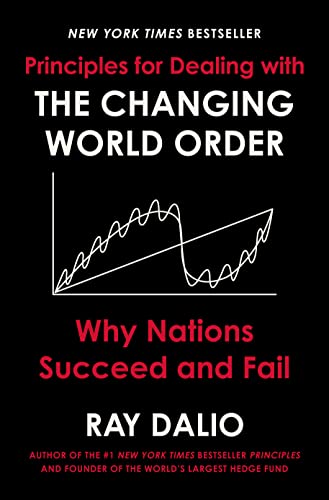 Get the book
获取本书
Get the book
获取本书
The Big Cycle
大周期
Dalio's central thesis: empires rise and fall in a repeating arc lasting roughly 250 years. The cycle spirals upward like a corkscrew — each era of destruction gives way to higher productivity — but within it, six distinct stages determine whether a nation is building, coasting, or collapsing.
达利欧的核心论点:帝国的兴衰遵循一个约250年的循环弧线,如螺旋上升的开瓶器——每一次毁灭都孕育着更高的生产力。而在周期之内,六个清晰的阶段决定了一个国家正处于上升、守成还是崩塌之中。
The Upward Corkscrew
螺旋上升的轨迹
History doesn't repeat — it rhymes on a spiral. Each Big Cycle plays out over roughly 250 years, with a dominant-power phase lasting 50–100 years. Rise phases (Stages 1–3) typically last 40–80 years; decline phases (Stages 5–6) compress into 10–20 years of painful restructuring. The pattern has driven Dutch, British, and American dominance — and Dalio believes it now governs the US–China transition.
历史不是简单的重复,而是在螺旋轨道上押韵。每个大周期大约持续250年,其中主导大国的鼎盛期约为50至100年。上升期(第1至3阶段)通常持续40至80年;衰退期(第5至6阶段)则压缩为10至20年的痛苦重组。这一规律驱动了荷兰、英国和美国的兴衰——达利欧认为,它如今也支配着中美之间的历史交接。
The Rise Phase — Stages 1–3 (typically 40–80 years)
上升期 —— 第1至3阶段(通常持续40至80年)
The New Order Begins
新秩序诞生
After revolution or war, new leadership consolidates power. Opposition is eliminated. Foundational institutions are established. This is the era of revolutionary fighters and consolidators who forge a new system from the ashes of the old.
革命或战争之后,新领导层巩固权力,清除反对势力,奠定制度根基。这是革命者与整合者的时代——从旧秩序的灰烬中锻造全新的体制。
System Building
制度建设
Leaders construct governance frameworks and economic systems designed to broadly benefit the population. "Civil engineers" — administrators who can design functional institutions — replace the fighters. Early prosperity takes root. Think post-WWII reconstruction or Singapore under Lee Kuan Yew.
领导者构建治理框架与经济体系,广泛惠及民众。"制度工程师"取代了战场上的斗士——他们善于设计高效机构。早期繁荣开始扎根,如二战后的重建、李光耀治下的新加坡。
Peace & Prosperity
和平与繁荣
The golden age. Widespread opportunity, productivity gains, broadening wealth, merit-based education, and entrepreneurial flourishing. Led by "inspirational visionaries" who maintain sound finances and peaceful international relations. Debt-fueled growth remains sustainable.
黄金时代。机遇遍地、生产力跃升、财富普惠、教育公平、创业繁荣。"远见卓识者"主导国家方向,维持健康的财政与和平的国际关系。举债驱动的增长尚在可持续范围之内。
💡 Stages 1–3 form the "Rise Phase" — typically lasting 40–80 years. The upward momentum feels permanent, but it plants the seeds of its own reversal.
💡 第1至3阶段构成"上升期",通常持续40至80年。上升的势头看似永恒,实则已悄然埋下逆转的种子。
The Decline Phase — Stages 4–6 (Stage 4 can last decades; Stages 5–6 compress to 10–20 years)
衰退期 —— 第4至6阶段(第4阶段可延续数十年;第5至6阶段通常压缩为10至20年)
Excess & Decadence
过度与衰颓
Prosperity curdles into unsustainable consumption. Debt accelerates. Wealth concentrates dramatically. Innovation fades. Rival powers emerge. Leadership grows overconfident and corrupt. Currency devalues. The gap between rich and poor becomes a chasm.
繁荣异化为不可持续的消费。债务加速膨胀,财富急剧集中,创新动力衰退,竞争对手崛起。领导层日益自负腐败,货币贬值,贫富差距成为不可逾越的鸿沟。
Crisis & Conflict
危机与冲突
Government finances deteriorate severely. Large deficits, unsustainable debt, money printing, and eroding borrowing power collide with wealth gaps that fuel populism on both left and right. The "classic toxic mix" — inadequate finances + large inequality + economic shocks. Dalio placed the US here in 2021.
政府财政严重恶化。巨额赤字、不可持续的债务、货币超发,叠加激化左右翼民粹主义的贫富鸿沟。这就是"经典毒性组合"——财政枯竭 + 严重不平等 + 经济冲击。达利欧在2021年将美国定位于此阶段。
Revolution
革命
Systems collapse as competing factions fight to establish new orders. Wealth and power are redistributed — often brutally. Debt is restructured. Capital controls emerge. Moderate voices disappear. In March 2026, Dalio declared the US has entered Stage 6. The cycle resets, leading back to Stage 1.
体制全面崩溃,各方势力争夺新秩序的主导权。财富与权力被重新分配——往往以残酷的方式。债务重组,资本管制出现,温和派的声音消失。2026年3月,达利欧宣布美国已进入第六阶段。周期重置,一切回到第一阶段。
💡 Stages 5–6 form the "Decline Phase" — typically lasting 10–20 years. History shows that "almost all wealth was destroyed or confiscated in most countries" during these transitions.
💡 第5至6阶段构成"衰退期",通常持续10至20年。历史表明,在这些转型期中,"大多数国家几乎所有的财富都遭到了毁灭或没收"。
"Human productivity is the most important force in causing the world's total wealth, power, and living standards to rise over time."
「人类的生产力是推动世界总体财富、权力与生活水平长期上升的最重要力量。」
— Ray Dalio, Changing World Order
—— 瑞·达利欧,《变化中的世界秩序》
The 18 Determinants of Power
衡量国力的18项指标
Dalio's Bridgewater team identified 18 measurable factors that determine a nation's strength and predict its trajectory. They form a self-reinforcing cycle: education drives innovation, innovation drives output, output drives trade and military strength — all the way to reserve currency status.
达利欧的桥水团队确定了18项可量化指标,用以衡量国家实力并预测其走势。它们构成一个自我强化的闭环:教育驱动创新,创新驱动产出,产出驱动贸易与军事实力——最终推高储备货币地位。
The Macro Forces
宏观驱动力
Three macro cycles form the structural foundation. Together they determine whether a nation is in ascent or decline, and whether conditions favor domestic stability or crisis:
三大宏观周期构成了国家实力的结构性基础。它们共同决定一个国家是处于上升还是衰退,以及国内局势是趋于稳定还是走向危机:
- Debt / Money / Economic Cycle — Financial health, debt levels, currency strength, central bank policy.
- Internal Order / Disorder Cycle — Political stability, social cohesion, wealth distribution, governance effectiveness.
- External Order / Disorder Cycle — International relationships, geopolitical position, alliances, conflicts.
- 债务 / 货币 / 经济周期——财政健康度、债务水平、货币强度、央行政策。
- 内部秩序 / 混乱周期——政治稳定性、社会凝聚力、财富分配、治理效能。
- 外部秩序 / 混乱周期——国际关系、地缘政治地位、联盟体系、冲突态势。
The Power Progression
实力递进链
These eight factors are mutually reinforcing — each feeds the next. Education is the long-leading indicator; reserve currency is the long-lagging indicator:
这八项指标相互强化,层层递进。教育是最具前瞻性的先行指标;储备货币地位是最滞后的指标:
- Education — quality and accessibility
- Innovation & Technology — advancement capacity
- Cost Competitiveness — labor costs, productivity
- Economic Output — GDP, growth rates
- Share of World Trade — export capabilities
- Military Strength — capabilities, global projection
- Financial Center Strength — capital markets depth
- Reserve Currency Status — global standing
- 教育——质量与普及度
- 创新与技术——技术进步能力
- 成本竞争力——劳动力成本与生产率
- 经济产出——GDP与增长率
- 世界贸易份额——出口能力
- 军事实力——军事能力与全球投射
- 金融中心实力——资本市场深度
- 储备货币地位——全球货币地位
💡 Education is the long-leading indicator — it rises first and its decline signals future trouble. Reserve currency status is the long-lagging indicator — it persists decades after other measures have declined.
💡 教育是最具前瞻性的先行指标——率先崛起,其衰落则预示未来的危机。储备货币地位是最滞后的指标——在其他指标已然下滑数十年后,它仍会惯性维持。
The Supporting Cast
辅助性指标
Seven additional factors that amplify or constrain the Power Progression above. They are harder to measure but impossible to ignore:
七项补充因素能够放大或制约上方的实力递进链。它们较难量化,但同样不可忽视:
- Natural Resources — geography, resource access
- Resource Allocation Efficiency — meritocracy
- Acts of Nature — pandemics, disasters
- Infrastructure & Investment — physical and digital
- Character & Determination — work ethic, resilience
- Governance & Rule of Law — institutional effectiveness
- Wealth & Opportunity Gaps — inequality, cultural cohesion
- 自然资源——地理优势与资源禀赋
- 资源配置效率——人才选拔的公平性
- 自然灾害——疫情、气候灾难
- 基础设施与投资——物质与数字基建
- 民族性格与决心——勤勉精神与韧性
- 治理与法治——制度有效性
- 财富与机会差距——不平等程度与文化凝聚力
💡 These 18 factors are mutually reinforcing: "Rising education leads to increased innovation and technology, which leads to an increased share of world trade and military strength" — a virtuous cycle going up, a vicious one going down.
💡 这18项因素相互强化:"教育提升带动创新与技术进步,进而扩大贸易份额与军事实力"——上行时是良性循环,下行时则成为恶性螺旋。
Empire Rise & Fall
帝国兴衰录
Four empires, four reserve currencies, one repeating pattern. Each rose through innovation and discipline, peaked through dominance, and fell through debt, inequality, and challenge from the next rising power.
四个帝国,四种储备货币,一个反复上演的模式。每一个都因创新与纪律崛起、因霸权而登顶、因债务、不平等与后来者的挑战而衰落。
The Dutch Empire ~1581–1795
荷兰帝国 约1581–1795年
Created the world's first publicly traded company (Dutch East India Company, 1602) and first stock exchange. At peak, controlled roughly 33% of global trade. The Dutch guilder became the first true world reserve currency. Decline: over-extension, loss of competitiveness, excessive money printing, bank collapse (1780s), and French invasion (1795).
创立了世界上第一家上市公司(荷兰东印度公司,1602年)和第一家证券交易所。鼎盛时期掌控全球贸易约33%的份额。荷兰盾成为第一种真正意义上的世界储备货币。衰落之路:过度扩张、竞争力丧失、货币滥发、银行挤兑(1780年代),最终被法国入侵推翻(1795年)。
💡 Pattern: financial innovation → trade dominance → overextension → money printing → collapse. Every subsequent empire repeated this exact sequence.
💡 规律:金融创新 → 贸易霸权 → 过度扩张 → 货币滥发 → 崩溃。此后每一个帝国都精确地重复了这一轨迹。
The British Empire ~1750–1960s
大英帝国 约1750–1960年代
At peak: 2.5% of world population generated 20% of global income and controlled over 40% of global exports. The pound became the dominant reserve currency backed by the gold standard. Won both World Wars — but emerged financially devastated. Pound devalued 30% (1949), then another 14% (1967), ending its reserve status.
鼎盛时期:以全球2.5%的人口创造了20%的全球收入,掌控超过40%的全球出口。英镑在金本位支撑下成为主导储备货币。两次世界大战均获胜——却因此在财政上元气大伤。英镑先后贬值30%(1949年)和14%(1967年),储备货币地位就此终结。
💡 Britain won the wars but lost the empire. Military victory masked financial decline — a critical lesson about confusing strength with sustainability.
💡 英国赢了战争,却输了帝国。军事胜利掩盖了财政衰退——这是一个关于"不能将实力等同于可持续性"的深刻教训。
The American Empire ~1945–Present
美利坚帝国 约1945年至今
Bretton Woods (1944) established the dollar as world reserve. Nixon abandoned gold backing in 1971. Dollar's FX reserve share has declined from over 70% (early 2000s) to under 60% today. National debt has surpassed $30 trillion. Dalio placed the US at Stage 5 in 2021, and by March 2026, declared entry into Stage 6.
布雷顿森林体系(1944年)确立了美元的世界储备货币地位。1971年尼克松废除金本位。美元外汇储备占比已从2000年代初的逾70%降至目前的不足60%。国家债务突破30万亿美元。达利欧在2021年将美国定位于第五阶段,2026年3月宣布已进入第六阶段。
💡 The "exorbitant privilege" paradox: reserve currency status allows excessive borrowing, which provides short-term power but creates long-term vulnerability through debt accumulation.
💡 "超级特权"悖论:储备货币地位允许过度举债,短期内带来权力,长期却因债务堆积埋下致命隐患。
The Chinese Empire Historical & Modern Rise
中华帝国 历史与当代崛起
Dominated Dalio's power index in the 1500s, then endured centuries of decline through the "Century of Humiliation" (1839–1949). Mao's revolution marked Stage 1 of a new cycle. Since Deng Xiaoping's reforms, real per capita income has multiplied 24× since 1984. Now the largest country by trade volume and second-largest economy.
1500年代在达利欧的国力指数中居于首位,此后经历了"百年屈辱"(1839–1949年)的漫长衰落。毛泽东的革命标志着新周期的第一阶段。自邓小平改革开放以来,人均实际收入自1984年起增长了24倍。如今已是全球最大贸易国和第二大经济体。
💡 China is following the same trajectory as every previous challenger: Netherlands vs. Spain, Britain vs. Netherlands, America vs. Britain — and now China vs. America.
💡 中国正沿着每一个前辈挑战者的轨迹前行:荷兰对西班牙、英国对荷兰、美国对英国——如今是中国对美国。
"Having a reserve currency gives a nation the 'exorbitant privilege' of being able to borrow more money, which gets it deeper into debt."
「拥有储备货币赋予一个国家'超级特权'——可以借到更多的钱,但也因此债台更高。」
— Ray Dalio, Changing World Order
—— 瑞·达利欧,《变化中的世界秩序》
Three Big Forces
三大力量
Three interconnected forces drive the Big Cycle. The most dangerous periods in history occur when all three converge simultaneously — as they did in the 1930s–1940s, and as they appear to be doing now.
三股相互关联的力量驱动着大周期。历史上最危险的时刻,正是三者同时爆发之时——1930至1940年代如此,当下亦然。
The Debt / Money Cycle
债务 / 货币周期
Countries borrow to fund growth and maintain power. Debt accumulates over generations until it becomes unserviceable. The choice: default or print money. Typically, money printing occurs — leading to inflation, currency weakness, and erosion of reserve currency status. The cycle resets through painful debt restructuring.
国家通过举债推动增长、维持霸权。债务代际累积,直至无法偿还。两条路:违约或印钞。通常选择印钞——随之而来的是通胀、货币走弱、储备货币地位侵蚀。周期在痛苦的债务重组中重置。
💡 Every 1% weakening of the USD pushes oil prices up 0.73% (ECB data). Currency decline has cascading real-world consequences.
💡 美元每贬值1%,油价上涨0.73%(ECB数据)。货币贬值的连锁反应波及真实世界的方方面面。
Internal Order / Disorder
内部秩序与混乱
The sequence: new order → prosperity builds → wealth gaps widen → political extremism emerges → taxes increase on the wealthy → capital flight → revenue shrinks → downward spiral → democratic systems challenged → strong populist leaders emerge → potential civil conflict. Wealth redistribution struggles drive most internal instability.
演进路径:新秩序确立 → 繁荣积累 → 贫富分化 → 极端主义抬头 → 对富人加税 → 资本外逃 → 财政收入萎缩 → 恶性循环 → 民主制度受到挑战 → 民粹领袖崛起 → 可能爆发内部冲突。财富再分配的斗争是大多数内部动荡的根源。
💡 US internal conflict levels are at their highest since 1900. When the gap between rich and poor becomes too large, the social contract breaks down.
💡 美国国内冲突水平已达1900年以来的最高点。当贫富差距大到无法忍受,社会契约便土崩瓦解。
External Order / Disorder
外部秩序与混乱
The dominant power establishes international rules and institutions. Rising rivals exploit gaps and challenge the order. Military spending demands escalate. Tests of power — trade wars, proxy conflicts, territorial disputes — multiply. Wars typically result when the established and rising powers cannot resolve disputes peacefully.
霸权国建立国际规则与制度体系。崛起中的对手利用规则漏洞发起挑战。双方军费开支竞相攀升。贸易战、代理人冲突、领土争端等实力试探此起彼伏。当守成大国与崛起大国无法和平解决分歧时,战争往往不可避免。
💡 The transition between world orders typically involves all three forces converging: debt crisis + internal revolution + external warfare. That's what makes these periods so devastating.
💡 世界秩序的更迭通常伴随三大力量的同时爆发:债务危机 + 内部革命 + 对外战争。正因如此,这些时期才如此具有毁灭性。
The China Factor
中国因素
China is the rising power in the current Big Cycle — following the same trajectory as every previous challenger. A civilization that dominated the 1500s, collapsed through the Century of Humiliation, and is now ascending at a pace that has redefined the global balance of power.
中国是当前大周期中崛起的力量——循着每一个前辈挑战者的轨迹前行。一个在1500年代称雄天下、经历百年屈辱后跌入谷底、如今以重塑全球格局之势再度崛起的文明。
Where China Sits in the Cycle
中国处于周期的什么位置
China is in the rising / ascending phase (Stages 2–3 of its own cycle) while the US is in the declining phase (Stages 5–6). This creates the classic "Thucydides Trap" — the dynamic where a rising power's growth threatens the established power, making conflict between them highly likely unless both exercise extraordinary discipline.
中国正处于自身周期的上升期(第2至3阶段),而美国则步入衰退期(第5至6阶段)。这构成了经典的"修昔底德陷阱"——崛起大国的增长威胁到守成大国,除非双方展现非凡的克制,否则冲突几乎不可避免。
Real per capita income in China has multiplied 24× since 1984 — the fastest sustained rise in national wealth in recorded history.
自1984年以来,中国人均实际收入增长了24倍——这是有据可查的历史上最快的国家财富持续增长。
Ascending Pillars
崛起支柱
Largest country by trade volume — trading partner of more nations than any other. Near-comparable economy to the US. Highest infrastructure rating globally. Rapid advancement in AI, quantum computing, semiconductors. Long tradition of meritocracy-based governance stretching back to the imperial examination system. Projected 10-year growth: ~4.0% (vs. US at ~1.4%).
全球最大贸易国,与更多国家建立了贸易伙伴关系。经济规模逼近美国。基础设施评级全球第一。人工智能、量子计算、半导体领域突飞猛进。自科举制以来的悠久选贤传统。预计未来十年增长率约4.0%(美国约1.4%)。
Headwinds on the Horizon
前路上的逆风
Rising debt levels comparable to US concerns. Demographic decline — aging population and falling birth rates. Restrictive government policies under Xi Jinping that weigh on investment. Financial market crackdowns. The renminbi has struggled to gain traction as a reserve currency candidate. Escalating geopolitical tensions over Taiwan, the South China Sea, and trade.
债务水平攀升,隐忧与美国相当。人口结构恶化——老龄化加速、出生率走低。习近平时代收紧的管控政策令投资承压。金融市场的整顿风暴。人民币在储备货币竞争中步履维艰。台海、南海及贸易领域的地缘摩擦持续升级。
Confucian Values, Capitalist Practices
儒家价值,资本主义实践
Dalio characterizes China as a "state capitalist" hybrid — blending long historical traditions of centralized governance with market-driven economic growth. He is notably more balanced on China than many Western commentators, viewing its rise as a natural historical pattern rather than an aberration. The Confucian emphasis on education, hierarchy, and collective responsibility shapes a fundamentally different approach to governance.
达利欧将中国定义为"国家资本主义"的混合体——将悠久的中央集权治理传统与市场驱动的经济增长融为一体。相较于多数西方评论者,他对中国的分析明显更为持平,将其崛起视为历史规律的自然展现而非异常现象。儒家对教育、等级秩序与集体责任的强调,塑造了一种本质不同的治理哲学。
"We are creating an alternative species that has enormous capacity to see past patterns and process many different ideas very quickly."
「我们正在创造一个替代物种,它拥有惊人的能力去识别历史规律,并以极快的速度处理大量不同的想法。」
— Ray Dalio, on AI
—— 瑞·达利欧,论人工智能
The 1930s Parallel
1930年代的历史回响
Dalio identified three contemporary parallels to the 1930–1945 period — the last time all three big forces converged simultaneously. The rhyme between then and now is, in his words, "eerie."
达利欧发现了当下与1930至1945年间的三重历史对照——那是三大力量上一次同时爆发的时期。用他的话说,今昔之间的相似"令人不寒而栗"。
Unprecedented Debt & Money Printing
史无前例的债务与印钞
The largest amounts of debt, the fastest rates of debt growth, and the greatest amounts of central bank money printing and debt buying since 1930–1945. The post-1945 world order is now 75+ years old — the US national debt has surpassed $30 trillion, and 60/40 portfolios have historically suffered 50% drawdowns during such transitions.
自1930至1945年以来最大规模的债务总量、最快的债务增速、最大规模的央行印钞与债务收购。战后世界秩序已运行逾75年——美国国家债务突破30万亿美元,而历史上在此类转型期间,传统的60/40投资组合曾多次遭受50%的回撤。
Extreme Wealth Gaps & Populism
极端贫富分化与民粹主义
The biggest gaps in wealth, income, and values — and the greatest amounts of populism — since 1930–1945. Left and right populism feeds on the same grievance: the system no longer works for ordinary people. Media distortion intensifies, rule-following deteriorates, moderate voices are drowned out.
自1930至1945年以来最大的财富、收入与价值观鸿沟——以及最猛烈的民粹主义浪潮。左翼与右翼民粹生于同一片土壤:制度已不再为普通人服务。媒体失真加剧、规则意识瓦解、温和派的声音被淹没。
Great Powers Conflict
大国冲突
The greatest international great powers conflict — especially US vs. China — since 1930–1945. Trade wars, technology restrictions, military posturing, and alliance reshuffling mirror the pre-WWII geopolitical landscape. The question isn't whether confrontation will happen — it's whether it can be managed without catastrophe.
自1930至1945年以来最激烈的大国博弈——尤其是中美对抗。贸易战、技术封锁、军事对峙、联盟重组,一切都映射着二战前的地缘政治格局。问题不在于对抗是否会发生,而在于能否将其控制在灾难性后果的门槛之下。
Great Powers Index
大国实力指数
Where the major powers sit today — with projected 10-year growth rates that signal where the balance of power is heading:
当前主要大国的实力排名,以及预示权力天平走向的未来十年增速:
~1.4% projected growth
预计增长约1.4%
~4.0% projected growth
预计增长约4.0%
~6.3% projected growth
预计增长约6.3%
💡 Singapore ranks lowest in total strength (0.24) but highest in per-capita strength (0.89) — proof that size and quality are very different measures of national power.
💡 新加坡的总体实力最低(0.24),但人均实力全球最高(0.89)——这证明国力的规模与质量是截然不同的衡量维度。
Key Takeaways
核心启示
Understanding the pattern is only the first step. Dalio offers concrete principles for navigating the changing world order — not as passive observers, but as informed actors making better decisions.
看清规律只是第一步。达利欧提出了应对变局的具体原则——不是做旁观者,而是做更明智的决策者。
History Rhymes — Predictably
历史不断押韵——且有迹可循
The same Big Cycle has played out repeatedly: Dutch → British → American. China is now rising as America shows signs of decline, following the identical pattern. These transitions aren't random — they follow measurable determinants that provide years or decades of warning. The pattern is the most powerful analytical lens available for understanding today's headlines.
同一个大周期反复上演:荷兰 → 英国 → 美国。中国正在崛起,美国呈现衰落迹象,轨迹如出一辙。这些转型绝非随机——它们遵循可量化的指标,提前数年甚至数十年发出预警信号。这一规律是理解当今时事最有力的分析框架。
Watch Education First
首先关注教育
Education is the earliest signal of a nation's future trajectory — it leads all other measures by decades. When education quality declines, innovation, competitiveness, and economic output eventually follow. By the time reserve currency status erodes, it's already too late.
教育是预判国家未来走向的最早信号——领先其他所有指标数十年。当教育质量下滑,创新、竞争力与经济产出终将随之走低。等到储备货币地位动摇时,一切已经太晚。
Diversify Globally
全球化分散配置
Dalio's practical advice: diversify across different assets, currencies, and nations. Don't depend on governments for financial security. Understand where you are in the cycle and adapt your strategy accordingly. The pre-1945 lesson is stark: "Almost all wealth was destroyed or confiscated in most countries."
达利欧的实操建议:跨资产、跨币种、跨国别分散配置。不要依赖政府来保障财务安全。认清自己处于周期的哪个阶段,据此调整策略。1945年前的教训触目惊心:"大多数国家几乎所有的财富都遭到了毁灭或没收。"
The Upward Spiral Continues
螺旋仍在向上
Despite destructive periods, the long-term trajectory points upward. Human productivity is the most important force driving the world's total wealth and living standards higher over time. The cycle is a corkscrew, not a circle — each revolution ends higher than the last. Yet Dalio warns: "typically the majority of people stay employed in depressions, are unharmed in shooting wars, and survive natural disasters." Prepare, but don't panic.
尽管破坏性时期令人痛苦,但长期轨迹仍然向上。人类的生产力是推动全球财富与生活水平持续提升的最根本力量。周期是螺旋而非圆环——每一次轮回都终结于更高的起点。但达利欧也宽慰道:"通常大多数人在萧条中仍有工作,在战争中未受伤害,在天灾中幸存下来。"居安思危,但无需恐慌。
💡 The AI factor may change everything. Dalio observes that humanity is "creating an alternative species" that could accelerate or disrupt the Big Cycle in ways no previous generation could have imagined.
💡 人工智能或许将改变一切。达利欧指出,人类正在"创造一个替代物种",它可能以前所未有的方式加速或颠覆大周期的运行。
Empires rise and fall by the same logic, in the same order, for the same reasons — and the only rational response is to study the pattern, watch the leading indicators, and act before the cycle acts on you.
帝国兴衰遵循同一逻辑、循着同一顺序、出于同一缘由——唯一理性的回应,是读懂规律、盯紧先行指标,在周期改变你之前,主动改变自己。